 |
U.S Afghanistan Iran International |
 |
 |
|
One month after the Epstein files deadline, only a fraction of the DOJ`s records have been released
Rep. Ro Khanna, D-Calif., one of the co-authors of the Epstein Transparency Act, called the Justice Department`s delay in releasing the files "an obstruction of justice."
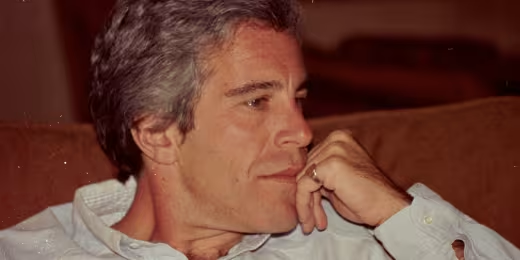
Monday marks one month since the deadline for the Justice Department to release all its files related to Jeffrey Epstein, but only a fraction of the records have been made public. The delays have frustrated Epstein`s victims and brought warnings of repercussions from the co-authors of the Epstein Files Transparency Act, Reps. Thomas Massie, R-Ky., and Ro Khanna, D-Calif. Massie claimed in a statement to NBC News on Friday that "Attorney General [Pam] Bondi is making illegal redactions and withholding key documents that would implicate associates of Epstein." His statement did elaborate further and it`s unclear what he was basing his claims on. The DOJ declined to comment on them but instead pointed to a recent court filing. In a separate statement Friday, Khanna said the "DOJ`s refusal to follow the law" is "an obstruction of justice." "They also need to release the FBI witness interviews which name other men, so the public can know who was involved. That is why Massie and I are bringing inherent contempt against Bondi and requested a special master to oversee this process," he said. "The survivors and the public demand transparency and justice," Khanna said. Reached for comment about Massie and Khanna`s statements, the Justice Department pointed NBC News to its response on Friday to a request from the lawmakers that a special master be appointed to oversee the release of the materials. The DOJ argued that Massie and Khanna do not have legal standing to make the request. "Accordingly, Representatives Khanna and Massie do not have standing to `raise issues concerning DOJ`s compliance with the Act`," the filing said. The filing was signed by Bondi, Deputy Attorney General Todd Blanche and Jay Clayton, the U.S. Attorney for the Southern District of New York. In a separate court filing on Thursday, the DOJ said it had "made substantial progress and remains focused on releasing materials under the Act promptly while protecting victim privacy." "Compliance with the Act is a substantial undertaking, principally because, for a substantial number of documents, careful, manual review is necessary to ensure that victim-identifying information is redacted before materials are released," the filing said. Victims have complained that the Justice Department is protecting the wrong people. In a letter to the Justice Department`s inspector general last week, a group of Epstein survivors and relatives of victims complained that the redactions to date had been "selective." "These failures have caused renewed harm to survivors and undermined trust in the institutions responsible for safeguarding sensitive information," the group said in its letter. "In multiple instances, names of individuals alleged to have participated in or facilitated abuse appear to have been redacted, while identifying details of survivors were left visible. In some cases, survivors` names, contextual identifiers, or other information sufficient to identify them publicly were not adequately protected," they added. They also complained, as have Khanna and Massie, that the Justice Department has not complied with another part of the law, which requires it to explain its redactions. "Without it, there is no authoritative accounting of what records exist, what has been withheld, or why, making effective oversight and judicial review far more difficult," an attorney for the congressmen argued in a filing. On Friday, lawyers for the Justice Department challenged Massie and Khanna`s request for a special master to oversee the release of the materials in a court filing, arguing the pair do not have legal standing to make the request. President Donald Trump signed the Epstein Files Transparency Act into law Nov. 19. The law gave the attorney general 30 days to "make publicly available in a searchable and downloadable format all unclassified records, documents, communications, and investigative materials in the possession of the Department of Justice" involving Epstein, "including all investigations, prosecutions, or custodial matters." On Dec. 19, the day the files were due to be made public, Blanche said in an interview with Fox News that the Justice Department was releasing hundreds of thousands of documents that day and that it could take a "couple of weeks" for the rest to come to light. He said the delay was needed to comply with the law`s directive that information about all of Epstein`s victims - of whom the Justice Department has said there are more than 1,000 - is redacted from the releases. The Justice Department said in a court filing this month that it had posted "approximately 12,285 documents (comprising approximately 125,575 pages) in response to the Act." In a court filing Thursday, it acknowledged that "millions" of pages of materials were outstanding. "To date, the Department has employed over five hundred reviewers to review and redact millions of pages of materials from the investigations into Epstein and his convicted co-conspirator," Ghislaine Maxwell, the filing said. The filing did not give a total number of files that are outstanding or say when they would be made public. Among the documents that have yet to be released are any internal discussions about a controversial joint memo the FBI and the Justice Department released in July, in which they said they had conducted an "exhaustive" review of the files and determined that there was not evidence to charge anyone else in the case and that no further information would be released. The memo was met with tremendous political backlash, some of it from supporters of Trump. Epstein died by suicide in his jail cell while he was awaiting trial on federal sex trafficking charges in 2019. Epstein had been investigated on similar charges a decade earlier but wound up pleading guilty to state charges involving a single underage victim after he reached a secret nonprosecution agreement with federal prosecutors in Florida. The deal resulted in Epstein serving just 13 months in a Palm Beach County jail, which he was allowed to leave almost daily via a work-release program and have his own private security detail. Maxwell is serving a 20-year prison term for conspiring to sex traffic minors.
|
 |
|
|
|
U.S
Afghanistan
Iran
International
Social
Economic
Articles |
Athletic
Read
Science
Medical
Interview
Art and Culture
Travel |
|